
Best Pension Plan in UAE | Retirement Planning in Dubai 2026
Retirement planning in Dubai is something every expat wants to do. But only a handful take action.
The rest wonder where all their income went and, why a decade of tax-free earnings didn’t translate into the freedom they dreamt of.
There is no fixed or definite pension. No social security. No automatic retirement system kicking in. End-of-service gratuity is a useful lump sum, but for most professionals working in Dubai it covers a small fraction of a 25-to-30-year retirement. If you don’t build your own retirement fund while you’re earning here, no one builds it for you.
This guide covers everything retirement planning in Dubai actually involves for expats:
- What end-of-service gratuity will and won’t do
- The pension options available in Dubai — DEWS, private pension plans, and international retirement plans
- The best retirement plans for Dubai residents in 2026
- Where most Dubai expats actually retire, and what that costs
- The Golden Visa route for retiring in Dubai
- The GAiM Plan framework I use to turn a tax-free Dubai income into lifelong financial independence
Why retirement planning in Dubai is different
Most retirement advice on the internet assumes you live in a country with a state pension, tax-advantaged retirement accounts, and lifetime residency. Dubai has none of these. The rules of the game here are unique.
No fixed pension for expats
The General Pension and Social Security Authority (GPSSA) provides retirement benefits to UAE nationals. Expats build their own retirement system, which, given Dubai’s tax-free income, can be a powerful advantage if planned deliberately
End-of-service gratuity is not a retirement plan
Statutory gratuity (paid under UAE Labour Law at the end of your employment in Dubai) typically works out to around 21 days of basic salary per year for the first five years of service, and 30 days per year thereafter, capped at two years of basic pay. For a professional earning AED 40,000 a month with 15 years of service in Dubai, that’s roughly AED 600,000–900,000 — a meaningful lump sum, but nowhere near enough to fund 25+ years of retirement.
DEWS — the DIFC workplace savings scheme
If you work for a DIFC-licensed company in Dubai, your gratuity may have been replaced by the DIFC Employee Workplace Savings (DEWS) scheme — a defined contribution plan introduced in 2020. DEWS is a step forward, but contributions are still calibrated to the old gratuity rate (5.83% of basic salary for service under 5 years, 8.33% thereafter). For most professionals, DEWS alone won’t fund retirement either. it’s one component, not the whole plan.
Visa-linked income
Unless you hold a Golden Visa, your right to live in Dubai is tied to your employment or business. Working into your 60s in Dubai is not always possible — many employers don’t renew contracts past a certain age, and the visa expires when the job does. Retirement planning in Dubai has to account for the possibility that your earning years here end before you choose to end them.
Most Dubai expats will retire somewhere else
The majority of Dubai’s working population will eventually retire outside the UAE — in India, the UK, Canada, the Philippines, Pakistan, Australia, or wherever home turns out to be. That means your retirement corpus has to handle:
- Currency conversion from AED to your destination currency
- Inflation in your retirement country, not Dubai / UAE
- Tax residency in the destination country (Dubai-UAE is tax-free, but your retirement country probably isn’t)
- A potentially different cost of living, healthcare system, and lifestyle
Planning to retire in Mumbai is mathematically different from planning to retire in Manchester. Your plan has to be built around the destination, not the launchpad.
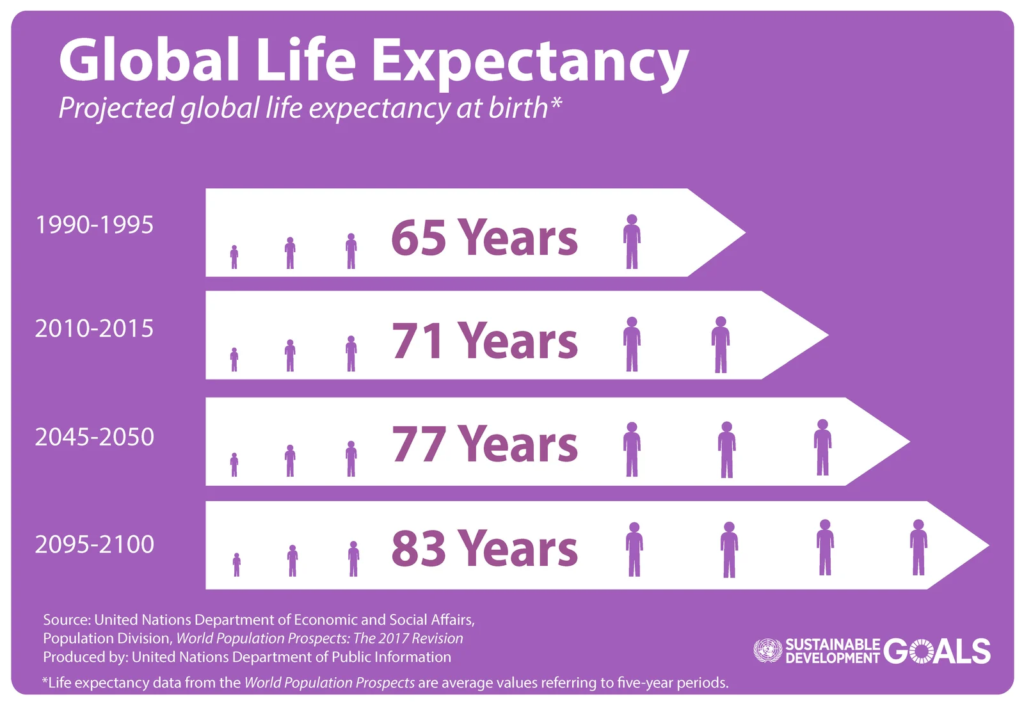
Longevity is increasing faster than retirement savings
Global life expectancy rose from 66.8 to 73.4 years between 2000 and 2019 (WHO). Healthy professionals living in Dubai routinely live into their late 80s and 90s. A retirement at 55 may need to fund 35+ years. Every extra year requires roughly 4–5% more corpus — the arithmetic is unforgiving.
Inflation — the silent risk of retirement planning in UAE
The biggest risk to your retirement isn’t a market crash. It’s inflation, both in the UAE while you’re earning, and in the country where you’ll eventually retire.
UAE inflation is higher than the headline number
The dirham is pegged to the US dollar, and headline UAE inflation averages 2–3%. But real lifestyle inflation for a professional family in Dubai often runs 4–6%, driven by:
- Healthcare: 5–8% (especially private and specialist care)
- International school fees: 4–6% annually
- Rentals: cyclical, with 15–25% jumps in boom years
- Basics (food, transport, utilities): 3–4%
A plan built on 2-3% inflation will leave you short. By the time most expats notice — usually around 45 — their savings are already behind their lifestyle.
Inflation in your retirement country is the bigger risk
You earn in AED, but if you want to retire somewhere else, the inflation rate of your retirement country determines how long your money lasts.
Approximate long-term averages:
- UAE, USA, Canada, Australia, Western Europe: 2–3%
- UK: 2–4%
- India (CPI): 5–6%, with healthcare and lifestyle inflation running 7–9%
- Egypt, Lebanon, and other non-GCC Arab countries: high single digits to double digits, with significant volatility
Why this matters
A retirement that costs AED 20,000 per month today will cost very different amounts in 20 years depending on where you spend it:
- At 3% inflation: ~AED 36,000 per month
- At 5% inflation (India): ~AED 53,000 per month
- At 7% inflation (India healthcare-heavy retiree): ~AED 77,000 per month
The corpus required to retire in Bombay or Bangalore is meaningfully larger than the corpus required to retire in Dubai, even though Bangalore costs less today. Inflation closes the gap, and then some.
What to do about it
- Plan in your destination currency, not AED.
- Apply destination-country inflation, not UAE headline rates.
- Hold some retirement assets in destination currency as retirement approaches.
- Stress-test the plan at +2% above your base assumption — if it still works, it’s a real plan.
Most retirement plans I rebuild for new clients have this exact gap.

What is retirement planning?
Retirement planning is the process of figuring out three things and turning them into a written, funded plan:
- What kind of life do you want when you stop working? (Where, with whom, at what standard of living.)
- How much money will that take? (Adjusted for inflation, longevity, and currency.)
- What do you need to do, starting this month, to get there? (Savings rate, asset allocation, insurance, contingencies.)
For a Dubai resident, the gap between today and that future is filled almost entirely by your own savings and investments. The tax-free income is the opportunity. The plan is the conversion engine.
Pension plans in Dubai — what expats need to know
Dubai doesn’t have a universal pension system for expats, but there are several pension-like options worth understanding.
GPSSA (for UAE nationals only)
The General Pension and Social Security Authority (GPSSA) is the federal pension system for UAE nationals working in both government and private sectors.
DEWS — DIFC Employee Workplace Savings
For employees of DIFC-licensed entities, gratuity has been replaced by DEWS — a funded, portable, defined contribution scheme. Employer contributions are made monthly (5.83% of basic salary for service under 5 years, 8.33% thereafter), and the employee chooses from a range of investment options. DEWS is portable — you keep it when you leave the job — but the contribution rate is rarely enough to fund retirement on its own.
ADGM Workplace Savings Plan
ADGM, Abu Dhabi’s financial free zone, has its own end-of-service savings scheme along similar lines. If you live in Dubai but work for an ADGM entity, you may be covered under that structure.
Private pension and retirement vehicles available in Dubai
Beyond employer-linked schemes, expats in Dubai typically build retirement using one or more of the following:
- International savings plans — Regular savings plans from Zurich, Sukoon, MetLife, and Salama. Disciplined monthly contributions, wide fund choice, advisor-led.
- Flexible investment plans — Lump-sum and top-up plans like the Zurich Wealth Accumulation Plan (WAP). Designed for capital already in hand — gratuity payouts, bonuses, investable surpluses.
- Direct investment portfolios — Global equity, bond, and ETF portfolios via offshore platforms like Ardan, Saxo, and Interactive Brokers. Lower cost, full flexibility, requires self-discipline.
- NRI mutual fund SIPs (for Indian passport holders) — AMFI-registered Indian SIPs accessible to NRIs in Dubai. Best for those retiring in India, exposed to INR–AED currency risk.
- LIC International pension plans — USD-denominated, capital-protected pension plans with both immediate and deferred annuity options. Suited for retirees prioritising stability over growth.
- REITs and dividend-yielding instruments — Supplementary income-generating assets, typically added in the late accumulation and decumulation phases.
Best retirement plans in Dubai for expats (2026) — how to choose
There is no single “best retirement plan” in Dubai. The right combination depends on your retirement age, destination country, monthly investment capacity, risk tolerance, and how hands-on you want to be. Here’s how to choose:
If you have 7+ years until retirement
A globally diversified equity-heavy portfolio does the heavy lifting. If you’re just starting, begin with a regular savings plan and convert your income into wealth, month by month. Consistency, market growth, and compounding take care of the rest. The earlier you start, the better.
If you have a lump sum to deploy (savings, gratuity, bonus, sale proceeds)
A flexible investment plan like the Zurich WAP, or a direct lump-sum investment via Ardan or Saxo, is usually more efficient. These structures allow both regular and ad-hoc top-ups, giving you the flexibility to invest on your terms. That said, keep some liquid savings aside in case life changes.
If you work in DIFC
DEWS is already running in the background. Don’t treat it as your full plan — supplement it with personal contributions through a regular savings plan or a flexible investment plan
If you’re within 5 years of retirement
The mix shifts toward stability — LIC International pension plans, structured products with capital protection, REITs for income, and a 2–3 year cash buffer in your retirement currency. This is also a great time to start building toward the Infinity Wealth Plan.
If you’re already retired or about to retire
The focus shifts from accumulation to generating reliable monthly income that lasts 25–30+ years. The Infinity Wealth Plan — my four-bucket retirement income system — allocates your corpus across cash, bonds, balanced, and equity buckets, generating sustainable monthly income while protecting against longevity risk, inflation, and market volatility. Designed specifically for UAE residents and retirees looking for lifelong income and a legacy for their loved ones.
UAE property as part of the mix?
Property can sit alongside the financial portfolio, but rarely replaces it.
AED rental income is useful. Capital appreciation can be meaningful. And property ownership supports Golden Visa qualification.
But liquidity is poor. Currency exposure is concentrated. And yields, after service charges and vacancies, are often lower than expected.
What I typically recommend
A retirement portfolio that doesn’t depend on any single asset class or any single source of income.
For most clients, the right combination looks something like this:
- The Infinity Wealth Plan — to convert the accumulated corpus into structured monthly income across four buckets (cash, bonds, balanced, equity)
- A property — for AED-denominated rental income and capital appreciation
- A pension plan — for guaranteed lifelong income through annuities (LIC International, deferred annuity structures)
- Cash reserves — for liquidity, emergencies, and the inevitable changes in life
The point isn’t picking the single best product. It’s building diversification across plans with different maturity periods, different income mechanisms, and different risk profiles — so no single market event, currency move, or life change can derail your retirement.
The mix is built around the client’s situation, destination, and timeline — not the other way around.
Retirement planning by life stage in Dubai
The right strategy depends on where you are in your career — and how many earning years you have left in Dubai.
Early career (20s and 30s)
This is the highest-leverage decade. Every AED invested now compounds for 30–40 years before retirement. The goals at this stage:
- Build an emergency fund of 3–6 months of expenses (liquid, in AED)
- Start a global equity-heavy investment portfolio with monthly contributions
- Get basic life insurance and critical illness cover while premiums are cheap
- Focus on consistent wealth accumulation. Avoid speculation, leverage, and risky assets like crypto when investing for retirement
- Get your will sorted early — DIFC, UAE Federal, and home-country. Especially if you have young children. Without a registered will, guardianship and custody decisions default to UAE inheritance law, not your intentions.
If you start investing AED 5,000 a month at age 28 with an 8% annual return, you’ll have over AED 7.5 million by age 60. The same plan started at age 38 ends up with around AED 3 million. Time is the variable you can’t buy back.
Mid-career (40s and 50s)
Income is typically at its peak. Family expenses are at their peak too. The goals shift to:
- Increase your savings rate aggressively — aim for 25–40% of income going to long-term wealth
- Diversify beyond equity into bonds, REITs, and income-generating assets
- Build a clear retirement number (corpus required, in destination-country currency)
- Review insurance — adjust life cover as liabilities decrease and assets grow
- Begin tax planning for your eventual repatriation country
- Update your will and estate plan — DIFC/ UAE Federal, and home-country, to reflect grown assets, changed family circumstances, and your intended distribution
Pre-retirement (within 5–10 years)
The focus shifts from accumulation to preservation and income.
- Reduce equity allocation gradually to protect against sequence-of-returns risk
- Build a 2–3 year cash buffer in your eventual retirement currency
- Stress-test your plan against early-retirement scenarios (job loss, health events)
- Decide where you’ll actually retire — and start moving assets in that direction
- Review your will — DIFC / UAE Federal, and home-country, and update it if anything has changed.
Where will you retire? The most-skipped question
Most retirement plans built in Dubai fail not because of poor investment returns, but because no one ever sat down and asked: where, specifically, will you spend retirement?
The cost of a comfortable retirement varies wildly by destination (AED-equivalent monthly spend):
- India (Tier 1 city — Mumbai, Bangalore, Delhi NCR): AED 10,000–20,000+
- India (Tier 2 city — Pune, Chennai, Coimbatore, Hyderabad): AED 5,000–14,000+
- UK / Western Europe: AED 10,000–40,000+, plus income tax exposure
- Canada / Australia: AED 10,000–35,000+, with significant tax implications
- Dubai (via Golden Visa): AED 15,000–45,000+ for a comparable lifestyle — no income tax, but high lifestyle costs
- Philippines, Malaysia, Thailand (retirement visa countries): AED 5,000–18,000
Pick the destination first. Build the corpus to fund it. Not the other way around.

Retiring in Dubai — the Golden Visa route
For expats who want to retire in Dubai, the Golden Visa for retirees offers a 5-year renewable residency for applicants aged 55 and above (with spouses and dependents included).
To qualify, you need to meet one of the following:
- A minimum monthly income of AED 15,000 (approximately USD 4,100), or AED 180,000 annually
- A 3-year fixed deposit of AED 1 million in a UAE bank
- Property worth AED 1 million in the UAE (owned outright)
- A combination of deposits and property totaling AED 1 million
This route is attractive for retirees who want to keep their Dubai base — for family reasons, lifestyle, access to high-quality private healthcare, or the tax-free environment. Most clients I work with on this route start positioning assets 5–10 years before retirement to qualify comfortably.
The 5 steps of retirement planning
This is the framework I work through with every client.
Step 1: When do you want to retire?
The earlier the age, the larger the corpus required, and the more aggressive the savings rate. A target retirement age of 50 versus 60 typically doubles the corpus needed.
Step 2: Where do you want to retire?
This determines the currency, cost of living, healthcare model, and tax exposure you’re planning around. Without this answer, every other number is a guess.
Step 3: What monthly income will you need?
In today’s money, in destination currency. Then adjusted for inflation between now and your retirement date.
Step 4: What’s the impact of inflation?
Inflation is the silent risk. At 5% annual inflation, AED 20,000 of monthly expenses today becomes roughly AED 53,000 in 20 years. Plans that ignore inflation underfund by 30–50%.
Step 5: How much corpus do you need?
Using a sustainable withdrawal rate (typically 3–4% per year) and adjusting for life expectancy and inflation, this gives you the target corpus. Then we work backwards: what monthly investment, at what return, gets you there?
The GAiM Plan — my comprehensive financial planning system
The GAiM Plan is the framework I use to deliver retirement planning that actually gets implemented — not just presented.
It covers four components:
- Goal Positioning System — defining retirement age, destination, lifestyle, and the corpus required to fund it
- Action Plan — specific monthly investments, asset allocation, and insurance recommendations
- Implementation support — helping you execute the plan, not just advise on it
- Quarterly and annual reviews — adjusting as markets, life, and goals change
Deliverables include a net worth statement with benchmarks, a retirement corpus projection, a written plan, a custom investment strategy, and a complete insurance needs analysis.
Learn more about the GAiM Plan →
Who I work with
I work with expat professionals in Dubai who want to retire on their own terms — not by accident, not by default, and not on whatever’s left over. They’re earning well, they’ve worked hard for the income they have, and they want to convert it into freedom that outlasts their career here. Most are in their 30s to 50s, often with families, and at the stage where every year without a plan is a year working harder than they need to.
If you’re at that stage, book a discovery call →
Frequently asked questions about retirement planning in Dubai
Do I need to plan for retirement in Dubai if I have end-of-service gratuity?
Yes. For almost every expat in Dubai, gratuity covers a small fraction of the corpus needed for a 25-to-30-year retirement. Treat it as one component — not the plan.
Can I retire in Dubai as an expat?
Yes, via the Golden Visa for retirees (age 55+), which requires either AED 15,000 monthly income, AED 1 million in a 3-year fixed deposit, AED 1 million in UAE property, or a combination of deposits and property totaling AED 1 million.
What’s the ideal retirement age in Dubai?
Most expats in Dubai target retirement between ages 55 and 60. The FIRE (Financial Independence, Retire Early) movement has pushed many professionals to aim for earlier financial independence. The right age depends on your corpus, lifestyle, and destination country.
How much do I need to retire as an expat in Dubai?
It depends entirely on where you’ll retire. For a Tier 1 Indian city, comfortable retirement typically requires a corpus of AED 4–8 million. For the UK or Canada, AED 8–15 million or more. For staying in Dubai via the Golden Visa, AED 10–20 million or more.
What is the best pension plan in Dubai?
There is no single best pension plan in Dubai — the right plan depends on your retirement age, destination country, savings capacity, and risk tolerance. Most expats end up with a combination of a globally diversified investment portfolio, a structured savings plan, rental property income, liquid cash savings and or a pension plan
Can I continue my Dubai investments after I leave the country?
Yes. The international investment plans recommended (Zurich International, Ardan, MetLife via offshore custodians) are designed to be held, managed, and accessed from anywhere in the world.
What happens to my gratuity when I leave Dubai?
Gratuity is paid out by your employer at the end of your service, usually as a lump sum in AED. How you deploy it — invest, pay off debt, transfer abroad — should be planned before the payout, not after.
Should I rely on Dubai property for retirement income?
Property can be one part of a retirement plan but rarely the whole plan. Rental yields in Dubai vary, vacancies happen, currency is concentrated, and selling property in an emergency takes time. Diversify across asset classes.
When should I start retirement planning in Dubai?
The day after you build your 3-month emergency fund. The earlier you start, the smaller the monthly investment required. Compounding does the heavy lifting if you give it time.
You worked hard to earn a tax-free income in Dubai. Make sure it lasts longer than you do.